The Business Framework
Align strategy, collaboration, execution, measurement, and improvement to create sustainable value for every stakeholder.
How Winning Works ?
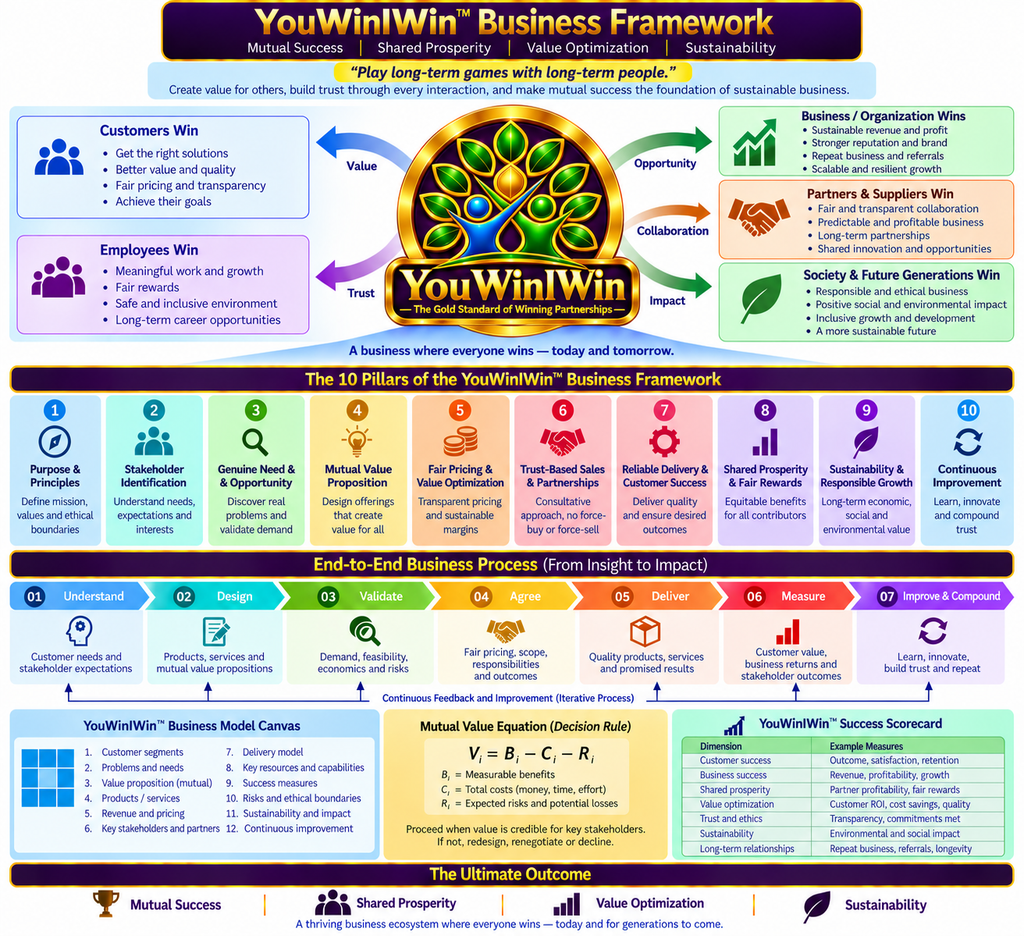
A practical framework aligning strategy, collaboration, execution, measurement, and continuous improvement to create sustainable value for every stakeholder.
How “Winning” Works in the YouWinIWin™ Business Framework
The meaning of winning: Beyond profit, beyond transactions
In the YouWinIWin™ Business Philosophy, winning does not mean defeating a competitor, securing the best deal at someone else’s expense, or maximizing profit from a single transaction. Winning means creating and realizing genuine value in a way that enables all participating stakeholders to achieve legitimate benefits and sustainable success.
The philosophy redefines business success from a one-time transactional outcome into a continuing cycle of value creation, value exchange, value realization, and shared prosperity.
Its fundamental question is not simply:
“Did I get what I wanted?”
It is: “Did we create enough genuine value for each other to succeed—and can we continue succeeding together?”
This distinction is the heart of YouWinIWin™.
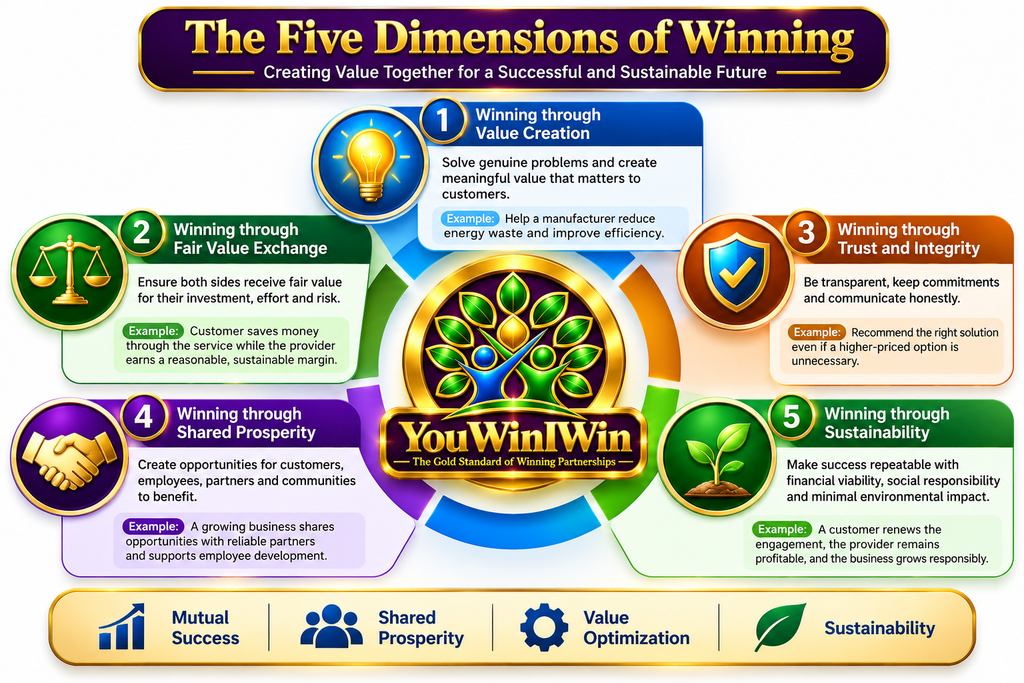
1. The five dimensions of winning
1. Winning through value creation
A business wins by solving a genuine problem, fulfilling a real need, or creating an opportunity that matters to its customer. The value must be meaningful, not merely claimed in a sales pitch.
Example: A consultant helps a manufacturer reduce energy waste and improve operational efficiency.
2. Winning through fair value exchange
The customer receives benefits worth the price, effort, and risk undertaken; the provider receives fair compensation for expertise, investment, resources, and delivery. Neither party needs to exploit the other for the transaction to be worthwhile.
Example: A customer saves money through a service while the provider earns a reasonable and sustainable margin.
3. Winning through trust and integrity
Both parties understand what is being offered, what it costs, what results are reasonably expected, and what risks remain. Promises are kept, limitations are disclosed, and problems are addressed honestly.
Example: A supplier informs a customer that a more expensive product is unnecessary for their requirements and recommends the better-fit option.
4. Winning through shared prosperity
The business relationship creates opportunities for the customer, provider, employees, suppliers, and relevant partners to benefit. Their rewards need not be identical; they should be fair in light of their contributions, responsibilities, and risks.
Example: A growing service business shares opportunities with reliable delivery partners instead of continually squeezing their margins.
5. Winning through sustainability
Success should be repeatable. The business must remain financially viable, customers should continue to receive value, and avoidable social or environmental harm should not be the price of growth.
Example: A customer renews a consulting engagement because the outcomes justify the investment, while the consultant remains profitable and capable of delivering quality.
Together, these five dimensions transform winning from a narrow financial result into a more complete measure of business success.
2. How winning works between “You” and “I”
The name YouWinIWin™ expresses a reciprocal relationship: the customer and the business provider each have legitimate interests, and both must be considered when designing a successful transaction.
YOU WIN
The customer receives genuine value, a suitable solution, fair terms, and the intended benefits.
I WIN
The provider earns fair returns, strengthens its reputation, and builds a sustainable business.
WE WIN TOGETHER
Trust • Mutual Value • Shared Prosperity • Long-Term Growth
Consider a simple example.
A business sells software for ₹1 lakh. The customer expects it to save ₹2 lakh in operating costs over a reasonable period. The provider incurs ₹60,000 in total delivery and support costs.
If the customer genuinely achieves the projected savings, the provider delivers as promised, and both understand the costs and risks, the transaction may create value for both.
However, the numbers alone do not prove that both parties have won. Implementation effort, maintenance costs, disruption, uncertainty, and the provider’s other obligations must also be considered.
The YouWinIWin™ principle is not that both parties must receive identical benefits. It is that both should have a credible, fair, and sustainable reason to participate in the relationship.
3. The winning cycle: How success compounds
The philosophy becomes especially powerful when winning continues beyond the first transaction.
01 Understand each other
Identify genuine needs, objectives, constraints, and expectations.
02 Create mutual value
Design an offering that solves the problem and supports a viable business.
03 Agree fairly
Establish transparent pricing, responsibilities, deliverables, and risks.
04 Deliver and realize value
Fulfil commitments and verify the outcomes achieved.
05 Build trust and prosper
Strengthen the relationship, learn, improve, and create further opportunities.
Repeat, improve, and compound
Each successful engagement can strengthen reputation, referrals, customer loyalty, and future opportunities.
This is where Naval Ravikant’s idea of playing long-term games with long-term people becomes relevant. In repeated relationships, trust and reputation can accumulate, making future cooperation more productive.
A business that sacrifices a small short-term advantage to preserve a valuable relationship may gain far more through repeat business, referrals, and collaboration over time.

4. What happens when one party is not winning?
YouWinIWin™ must be more than an aspiration. It needs a decision rule for difficult situations.
| Situation | YouWinIWin™ response |
|---|---|
| Customer receives poor value | Improve the solution, adjust the price or scope, or provide an appropriate remedy. |
| Provider cannot earn a viable return | Redesign delivery, revise the commercial terms, or decline the engagement. |
| Customer is pressured to buy | Stop pressure-based selling and restore informed, voluntary choice. |
| A proposed solution does not fit | Recommend a more suitable alternative, even if it generates less revenue. |
| Stakeholders disagree about rewards | Negotiate transparently, considering contributions, risks, responsibilities, and agreed commitments. |
| The relationship is no longer viable | Seek a fair resolution or orderly exit rather than perpetuating a harmful arrangement. |
Winning does not mean every negotiation ends with everyone’s preferred outcome. Nor does it mean every stakeholder receives a guaranteed profit.
It means the business actively seeks a fair, informed, and sustainable arrangement rather than creating success through deception, coercion, or deliberate exploitation.
5. How to measure whether each party has won
The framework should distinguish between promised value, delivered value, and realized value.
Customer winning indicators
Problem solved, expected outcomes achieved, fair total cost, satisfactory quality, and willingness to continue.
Business winning indicators
Sustainable margin, timely payment, manageable risk, customer retention, reputation, and healthy cash flow.
Ecosystem winning indicators
Fair partner rewards, reliable suppliers, employee development, responsible conduct, and positive wider impacts.
These measures should be agreed upon where practical, tracked over time, and reviewed when expectations are not met.
6. The ultimate distinction: Winning once versus winning repeatedly
Transactional winning
Close the deal, maximize the immediate gain, and move on.
May deliver a short-term result without creating a lasting relationship.
YouWinIWin™ winning Create genuine value, earn trust, deliver results, and build the next opportunity. Aims for recurring mutual benefit and sustainable growth.
A business can win a negotiation and still lose the customer. It can maximize a sale and damage its reputation. It can report strong revenue while weakening the relationships on which its future depends.
The defining principle of winning
YouWinIWin™ seeks to avoid these contradictions by aligning commercial success with customer outcomes, ethical conduct, and long-term value.
In YouWinIWin™, winning is not about getting more at someone else’s expense. It is about creating more value together, exchanging that value fairly, realizing the promised benefits, and building relationships in which everyone has a sustainable reason to win again.
YouWinIWin™ — The Gold Standard of Winning Partnerships.
Win Together
Align strategy, collaboration, execution, and measurement to create sustainable value for every stakeholder.